
Depression.1 Anxiety.12 Obesity.2 Risky behavior.3,4 Accidents.5 Antisocial behaviour.6 Misdiagnosis.4 Dropping out of school.6,7 Difficulty finding employment.8,9 Interactions with the criminal justice system.10,11 These are just some of the possible impacts of poorly managed ADHD.
Despite the availability of diagnostic tools and treatment options, ADHD is often under-diagnosed and under-treated.12 As a result, many people do not receive appropriate care and treatment options that are recommended in clinical guidelines.13
It’s been difficult for policymakers to demonstrate the budget impact of investment in interventions to improve access to treatment for people living with ADHD.
To help address this, Takeda has commissioned a budget impact analysis model which uses aggregated data to estimate the impact of untreated ADHD in 12 countries.
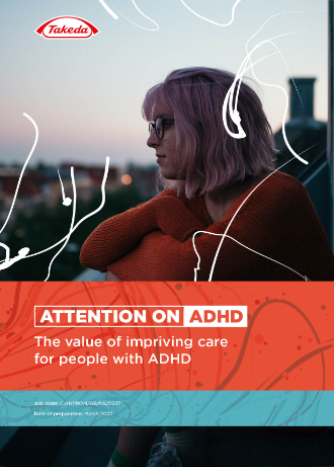
Read our ‘Attention on ADHD’ report, which uses a new budget impact analysis model commissioned by Takeda to show the value of increasing treatment rates to realise healthcare and social savings.
1. Katzman, M.A., Bilkey, T.S., Chokka, P.R. et al. Adult ADHD and comorbid disorders: clinical implications of a dimensional approach. BMC Psychiatry 17, 302 (2017).
2. Faraone, S. et al (2021). The World Federation of ADHD International Consensus Statement: 208 Evidence-based conclusions about the disorder. Neurosci Biobehav Rev. 128:789-818
3. Chen, M. et al. (2018). Sexually transmitted infection among adolescents and young adults with attention-deficit/hyperactivity disorder: a nationwide longitudinal study. J. Am. Acad. Child Adolesc. Psychiatry 57, 48–53.
4. Center for ADHD Awareness Canada (CADDAC) (2013). Paying Attention to the Cost of ADHD. The Price Paid by Canadian Families, Government and Society. Available at: <https://bcadhd.com/wp-content/uploads/2013/09/Paying-Attention-Paying-Attention-to-the-Cost-of-ADHD.-The-Price-Paid-by-Canadian-Families-Government-s-and-Society-caddac-for-Canadian-ADHD-Awareness-week-.pdf>. [Accessed January 2023].
5. Chang, Z., et al (2014a). Serious transport accidents in adults with attention-deficit/hyperactivity disorder and the effect of medication: a population-based study. JAMA Psychiatry, 71(3); 319-325.
6. Young, S., et al (2013). ADHD: making the invisible visible. An Expert White Paper on attention-deficit hyperactivity disorder (ADHD): policy solutions to address the societal impact, costs and long-term outcomes, in support of affected individuals. Available at: <http://www.russellbarkley.org/factsheets/ADHD_MakingTheInvisibleVisible.pdf> [Accessed January 2023].
7. O’Regan, F., (2009). ‘Persistent disruptive behaviour and exclusion’. ADHD in Practice, 1(1):8-11.
8. Gjervan, B., et al (2012). Functional impairment and occupational outcome in adults with ADHD. J Atten Disord; 16: 544-552.
9. Halmoy, A., et al (2009). Occupational outcome in adult ADHD: impact of symptom profile, comorbid psychiatric problems, and treatment: a cross-sectional study of 414 clinically diagnosed adult ADHD patients. J Atten Disord; 13: 175-187
10. Young, S. et al (2014). A meta-analysis of the prevalence of attention deficit hyperactivity disorder in incarcerated populations. Psychological Medicine, 45(2), 247-258.
11. Young, S., et al (2019). Attention Deficit Hyperactivity disorder (ADHD) in the prison system. Current Psychiatry Reports. 21:41.
12. Ginsberg Y, Quintero J, Anand E, Casillas M, Upadhyaya HP. Underdiagnosis of attention-deficit/hyperactivity disorder in adult patients: a review of the literature. Prim Care Companion CNS Disord. 2014;16(3):PCC.13r01600.
13. Sobanski E. (2006). Psychiatric comorbidity in adults with attention-deficit/hyperactivity disorder (ADHD). Accessed via: https://link.springer.com/article/10.1007/s00406-006-1004-4. [Accessed January 2023].